


On June 26th, a fireball shot across the Atlanta sky, crash landing in a residential home. People from all over the Southeast saw it, with some as far as Tennessee and the Carolinas saying they saw the streak. And for over a month, we’ve been wondering… what was that!?
Well, now we’ve got all the details! Keep scrolling to learn all about the newly named McDonough Meteorite!
What is the McDonough Meteorite?

Researchers at the University of Georgia say that this bolide, which is another name for a fireball or bright meteor, is in fact a very old specimen. Older, actually, than the Earth itself, at 4.56 billion years old. That’s a pretty old piece of space rock.
Before the meteor broke into analyzable fragments, researchers clocked the bolide entering the atmosphere at cosmic velocity. That’s a massive rock hurtling toward McDonough faster than the speed of sound. Of course, by the time a bolide gets closer to Earth’s surface, it does diminish in speed and size. But a fast traveling rock the size of a cherry tomato is nothing to sneeze at.
How big was the meteorite?

Researchers say that the McDonough Meteorite was roughly the size of a cherry tomato, with roughly 23 grams of fragments.
Researcher Scott Harris at the University of Georgia said,
This is something that, you know, coming through the house likely was on the upper end of what a high performance military rifle can do. And so, it’s kind of maybe a little bit instructive to think about the size of this, too. We estimate the object as it was coming through the house was about the size of a large cherry tomato. That’s about twice the size of a 50-caliber shell.
Where did the McDonough Meteorite land?

Since this meteor was seen all over the southeast, many people were unsure of where it actually landed. It turns out, part of it actually landed in a residential home in Henry County. The homeowner then turned the specimen over to a UGA planetary geologist and impact expert.
Harris said,
It was under so much stress that it just broke apart in its flight probably a couple of miles still up in the atmosphere. And then those pieces made it to the ground as individual meteorites that have been collected by meteorite hunters, by some local residents. But one of them actually penetrated a house –– went right through the roof, through the ceiling and into the floor. And we’ve had the pleasure and the opportunity to examine that –– both the rock as well as the dynamics of the entry through the house.
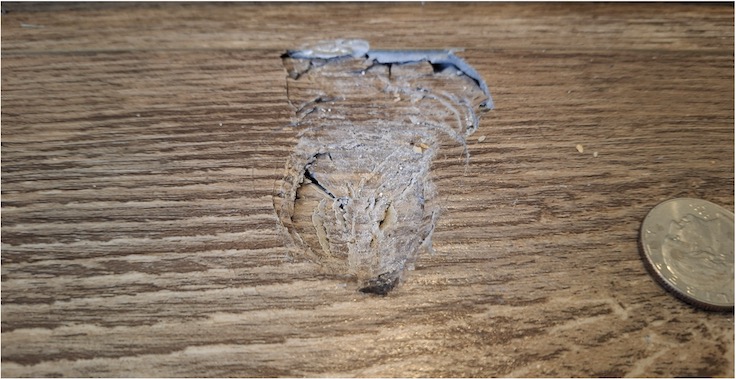
Even after slowing down upon entering the Earth’s atmosphere, the meteorite still had enough impact to go through the roof and HVAC duct, and leave a solid dent in the homeowner’s floor.
What’s next?
In addition to finalizing its lineage, UGA is working with colleagues at Arizona State University to submit their findings, along with the name McDonough Meteorite, to the Nomenclature Committee of the Meteoritical Society.
This is all to say, space is pretty cool!